‘Can I have my photograph taken with you?’ – Attempt #1

I’ve had cause, recently, to take stock. This has, for the most part, taken the form of perusing shoe-boxes full of old tat. Some of it to do with my career as a stand-up comic (more of that here) such as the rotor arm from my much loved Ford Granada 2.8 V6 injection – the roadside repair that got me to a gig at Cardiff Jongleurs, fashioned with an AA man’s soldering iron, still plainly evident.

rotor arm

It’s rather belated, I know, almost fourteen years in fact, but a big thank you to the Automobile Association. Especially to the technician who refused all attempts at financial reparation, instead producing a camera from his toolbox and insisting we have our photograph taken together – in the rain, on the hard shoulder of a Welsh motorway.

 Thanks for getting me there, mate. I simply couldn’t have died on my arse that night without you.

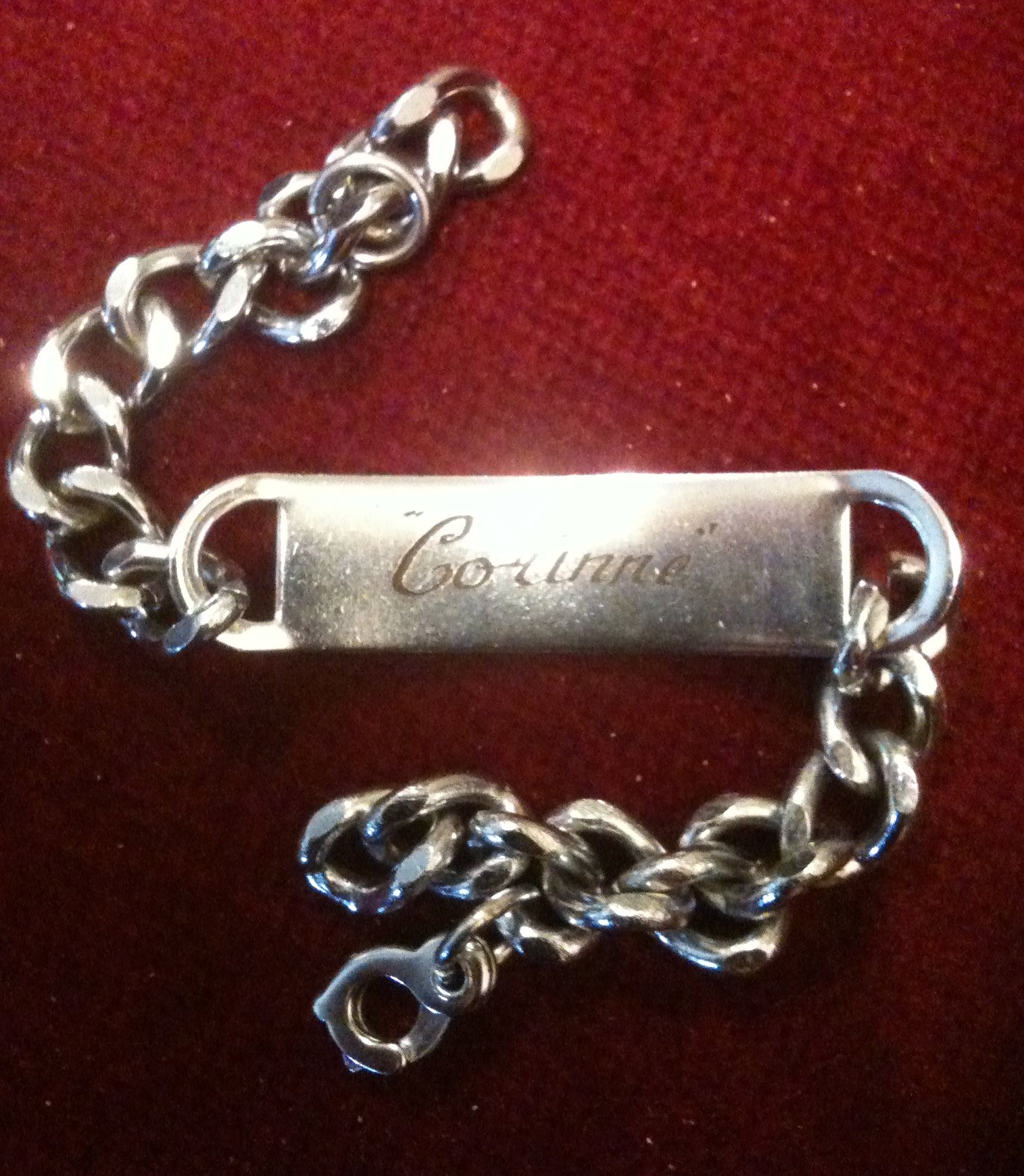
Another relic from the same box is in the shape of a rather heavy, but very cheap, chrome bracelet with a curved nameplate. On the visible side, the name of a young love, Corinne – on the reverse, my own. I believe this was one of a pair – the other worn, for an equally short time, by her.  

bracelet

My abiding memory of Corinne was standing in a telephone box in Plymouth, soaking wet from the Atlantic storm raging outside.

We steamed as we shared the earpiece and listened to the cries of my fiancé, in Liverpool, as I broke off our engagement. Her name was Cecilia. We lost our virginity together, in my mother’s bed, never to find it again.

I loved Cecilia dearly, but she was seven hours away by train and I was desperate to get into any bed whatsoever, with anybody whomsoever, and Corinne was standing next to me – soaking wet, and steaming.

I’ve thanked the AA, so perhaps, too, an apology is longer still overdue – I’m sorry, Cecilia. I really am. In mitigation I was three weeks away from being seventeen years old.

Phew

Anyway, most of the space in these boxes, once taken up by shoes, is occupied by photographs. None of Corinne or Cecilia as it happens – I know this as two months ago, in another hemisphere entirely, I ploughed through each one, mentally documenting their contents before packing them away, ready for transit. It’s why I’ve searched through packing crates to find them, and I’m again ploughing through pictures of people long dead with names long forgotten, family shots mixed in amongst old forces photographs, and pictures of literally hundreds of comedians in innumerable green-rooms in unmentionable clubs.

Right now I’m looking for one photograph in particular, one that I saw two months ago? I’m sure it was in this particular box?

It’s not that it has relevance to the piece, which was meant to be loosely based around the theme: ‘Can I have my photograph taken with you?’, (Sorry, I’ll do that later, now) it’s just that I thought of it – the photo, that is – and now I have to find it? It’s a childhood photo taken when I was seven, possibly eight. In it I’m holding a Jam Jar and in the Jam Jar, a goldfish, both recently acquired at a local fairground utilising a – until then unknown – talent for throwing three darts into a barn door.

The reason my interest has been piqued is that it must be the last shot of a goldfish in a Jam Jar before the great paradigm shift occurred and the iconic Jam Jar was consigned to history, replaced forever by the onset of modernity and the introduction of the Clear Sealed Plastic Bag. How this must have blighted the Jam Jar manufacturing industry is anyone’s guess. How many workers, families of workers, generations of families of workers, were to be torn apart within the space of one summer to another?

None, perhaps, but its effects on Goldfish rights were to be immense: gone were the pressures to carefully return your Goldfish home, unsullied and unspilled, to sit on the kitchen window to be studied and stirred with a spoon before death by overfeeding. Now, in this new commoditised, throw-away world, your golden fair-ground winnings could be cast into a Nike sports-utility-back-pack and, after accompanying you on numerous fair-ground rides, be thence transferred to a bedroom cupboard or drawer were said goldfish would wait, caterpillar like, to be magically transformed, over a period of weeks, or occasionally months, into a bag of milk.

I preferred the Jam Jars, and I’m sure the Goldfish did, too.

At one summer fair – it was the year before the lost photo was taken, I believe – I watched helpless as three darts flew through the air as if in slow motion. I knew almost before they left my hand that they were heading in a direction other than the intended target. The fact that I’d thrown all three in one go did nothing to allay the suspicion that they were intentionally aimed at the Copper standing on the far side of the stall. To avoid any such confusion I grabbed my little brother by the arm and ran like hell.

We returned later to try again only to find the stall owner in great fettle and overjoyed to see me. So much so he presented both myself and my little brother with a free Goldfish each.

His died first. I knew it was his as mine had a small black dot on the edge of its fin – not fin-rot, you understand, more of a fishy birth-mark. I’d noticed it early on and said so, out loud, and in front of adults, “Mine is this one with the little black dot on its fin!” We’d agreed and shook on it.

So his was dead, and mine was alive. I had the unenviable task of waking him and telling him that his Goldfish – definitely his Goldfish – was dead. Floating on the surface of the water. Dead as a Jimmy Nail. It was without doubt the greatest moment of my life. His was dead. Mine was alive! It was better than losing my virginity – it really was, sorry Cecilia, that was brilliant, really, honestly, truly brilliant, and beautiful… truly beautiful – and thank you – but this was better. His was dead. Mine was alive!

Strangely, the following morning, my goldfish, obviously pining for its overfed companion, committed suicide. It had, quite bizarrely, leapt out of the Jam Jar, soaring a full three feet before impaling itself squarely onto a kitchen fork. I wouldn’t have believed it had my little brother not seen it with his very own eyes.

A fleeting moment of joy at the misfortune of others, dashed onto the rocks of sadness. Sometimes we get what we deserve. I got Corinne and a bracelet – I hope Cecilia got the money back on the ring?

Anvil Springstien.

Ps: This post went somewhere else other than where it was supposed to go? It was meant to explore the background to the upcoming Photo Album shot from the Cassini Space Probe to take place on the 19th July 2013, recreating Sagan’s famous Pale Blue Dot shot from Voyager 1.

Yes, yes, I know, doh! Sometimes you just have to go where the words take you – they took me here. I was searching, initially, for the rotor arm remembering the AA man had taken our photo – then found the bracelet in the same shoe-box and…

I’ll post the shots of both in a short while.

And I’ll revisit the original idea over the next week or so.

Sorry.

Islamic Golden Age.

The many recent articles on the recent French liberation of the north Malian town of Timbuktu tell us that an estimated 2000 irreplaceable manuscripts on science, astronomy, algebra, optics, and the like, have reportedly been destroyed by the retreating Islamists of Ansar Dine.

As an aside, in the continuing Syrian civil war we hear of similar actions during the brutal imposition of shariah by Islamist rebels in the northern town of Aleppo, birthplace of al Ma’arri, a 10th century poet who railed against Islam and religion in general; “Inhabitants of the earth are of two sorts: those with brains, but no religion, and those with religion, but no brains.”. His statue, in his hometown, now stands broken and headless.

It should be noted with regards to Timbuktu, however, that no evidence of specific texts or manuscripts being burnt have materialised beyond a few piles of ashes and photographs of strewn protective storage covers for codices.

That theses works were perceived to be in danger, though, is sadly beyond doubt – and we can be thankful to the ingenuity and undoubted bravery of certain Malians who hid and smuggled whole collections of books from Jihadists, who, through purifying Islam from idolatry and heresy, are intent on returning the Ummah to what was recently described as The Golden Age of Islam.

It is a description of a period of Islamic history that we are hearing more and more of just recently, both from Islamists who use the phrase to inform us that only Islam can return us to such an obviously much needed period – and from their opponents, mostly secular, who insist that no such age could have ever existed, and cite the call from the pious which says that ‘only through Islam’ (and the imposition of the shariah) can we create a renaissance of this ‘Golden Age‘, as nothing more than the cry of the propagandist, or worse, the ignorant.

So was there a ‘Golden Age’? If so, when was it? Why did it come about, and, more importantly, what, or who, caused it to end? Furthermore, why would Islamists seek to destroy the libraries and cultural icons of present day Muslim communities, and will this destruction bring about a Second Golden Age of Islam?

To begin to understand this we first need to grasp the position that Timbuktu holds in this narrative;

Timbuktu.

Timbuktu, before its decline in the late 16th century, was seen as a commercial hub, a centre for slave trading, and a historic seat of Islamic learning. It was, and is, famous for its libraries, and well placed, geographically, for the preservation of texts and manuscripts.

It is for these libraries, and their unique method of construction, along with its significance to the spread of Islam in Africa, that has seen Timbuktu designated a UnescoWorld Heritage site since 1988.

Situated north of the Niger River on the southern rim of the Sahara desert, Timbuktu first came to prominence in the early decades of the 14th century with the rise of the Mali Empire (c. 1230 – c. 1600 CE). Changing economics placed it in an advantageous geographic and the trade routes now passing through it brought prosperity and imperial favour.

Soon its growing religious university (or madrasah) – as large as any in the known world – was to be become renowned throughout Islam.

Timbuktu experienced a rapid expansion during this period and by the mid 14th century could boast around 100,000 inhabitants – a full quarter of these as students, scholars, and scribes at the madrasah.

It is through these very scribes that Timbuktu would become equally famous for its production and trade in books – and books, throughout the medieval period, meant knowledge – and knowledge, in this era no less than our own, held the means of authority, dominance, and control.

It should be understood here that books were also thought to hold the pathway to God and Godliness. Books were the Philosophers Stone. The visible seat of temporal and spiritual power.

It is why, in the search for power, they were both collected and destroyed.

The libraries of the defeated have always made both good loot, and good kindling.

So is this latter then the reason the world may have witnessed the loss of irreplaceable books and manuscripts along with the destruction of historic Sufi shrines in Timbuktu?

Could this be Ansar Dines attempt to wipe out its opponents both physically and historically, as they march us toward a second Islamic Golden Age, or is this merely the vandalism of war?

In order to answer these important questions we need to take our leave of Timbuktu and look further into the history of Islam for interestingly, regardless of its great role in the dissemination of Islam in Africa, Timbuktu was not founded until the 12th century and therefore follows long in the wake of what can truly be described as an age of flourishing in Islamic thought.

This age of flourishing, this Golden Age, has its roots in an earlier century, a greater city, and another empire entirely.

The Abbasid Caliphate – Islam’s Golden Age.

Historians widely regard this period to be that of the Abbasid Dynasty (750-1258 CE) which was the third of the Islamic Caliphates and an empire that was to last for over half a millennia. This longevity has to be observed against a timeline of Islamic expansion that, since Mohammed to even more recent times, would see ‘Islamic’ empires and dynasties popping in and out of existence rather like soap suds. Literally in their hundreds.

Nevertheless, the relative stability of the third Caliphate over such a length of time created agriculture, trade, taxation, bureaucracy, and the building of cities and schools, and brought with it all the trappings of the imperial court. Intrinsic to this was the accumulation of knowledge – of culture, and of power. The accumulation of books.

Thus, as medieval Europe edged itself deeper into darkness, the Abbasid ‘Empire’ was to come across the known and available philosophies of the day. The philosophies of the Ancients. These were studied, copied, translated, and developed – and this study, this discourse, brought Islamic culture nearer to God, and its adherents therefore, closer to godliness.

One major technological achievement which hastened this godly rush was the importation of paper making from China. The significance of the paper-mill to book production was as great as steam was to the Industrial Revolution.

Cheaper, faster, and better quality book production, allied with other advances of the Abbasid dynasty, created a revolution in the dissemination of knowledge and information, and led to a vast increase in philosophical and scientific debate that must parallel much of our own experience with the Internet.

It produced, amongst many others, these giants in the history of natural philosophy:

Al Kindi (801-873 CE). Regarded as the Father of Islamic Philosophy for introducing Greek thought to the Arabic world. A founding philosopher of Baghdad’s ‘House of Wisdom’, and instrumental in introducing Indian numerals to the Arabic and European worlds.

Al Farabi (872-950 CE). Musician, logician, alchemist, philosopher. Of whom Maimonides was to call ‘The Second Master’, Aristotle being ‘The First’.

Al Rawandi (827-911 CE). Freethinker and vociferous critic of religion, heretic, and possibly an atheist, who championed the primacy of intellectual thought over that of revealed religion.

Al Razi (865-925 CE). Persian polymath, physician, philosopher, and alchemist. Celebrated as the greatest physician of his day.

Al Ma’arri (925-1058). Mentioned briefly, earlier. Poet and rationalist, whose satirical criticism of Islam and religion in general was lauded in the salons of Baghdad.

Avicenna (980-1037 CE). The most famous of all the philosopher scientists of the Abbasid Caliphate. His books on medicine were standard texts throughout medieval Europe.

Averroes (1126-1198 CE). A product of the Al Andalus Caliphate. Known as the link between ancient Greece and a Europe emerging from the slumber of darkness. A man who Aquinas called ‘The Commentator’ in reference to his influential works on Aristotle, and regarded as a significant figure in the European Renaissance.

Theirs was a world moving forward at a significant pace – the thirst for knowledge bolstered by patronage and a belief that God intended this knowledge to be found, to be discovered – the unfolding of which revealing nothing less than the splendour of creation.

Science becomes Haram.

It is in this context that one of the most influential characters in Islamic history al Ghazali (1058-1111 CE) enters the narrative, for it was his thesis, ‘The Incoherence of the Philosophers‘ (11th century, obviously) which positioned, for the first time, Hellenistic science as being anti-Islamic, and is posited by many as beginning the decline of scientific understanding in the Abbasid Caliphate.

In ‘The Incoherence’, al Ghazali tackles the Aristotelian position developed by al Farabi and Avicenna with specific reference, amongst other things, to causality (creation), the nature (or otherwise) of a concerned and interventionist God, and the (heavenly) re-composition of tissue after death.

Not only did he take issue with the logic employed to attain such neoplatonic views that questioned the above, he further argues that such positions, being unfounded, should submit unquestioningly to religious revelation.

Put simply, al Ghazali’s stance is that if there exist natural laws then God is not omnipotent. To study the limits of natural laws in any metaphysical way is to suggest such, and is therefore heretical.

This is the Islamic philosopher that Weinberg refers to in his famous polemic regarding accommodationism (Beyond Belief 2006) where he informs us that al Ghazali rejected the very notion of laws of nature as these would “put Gods hands in chains”.

Al Ghazali’s philosophical position, allied with his political strength, underscores the end of a discursive interpretation of the Koran – of ‘God’ – and marks a shift toward literalism. His standing as a Muslim jurist allowed him to append a fatwa to the ‘The Incoherence’ stating that the teaching of any metaphysics which challenged such revelation to be blasphemous and the work of unbelievers or apostates – the penalty for such, then as now, being death.

It is of worth repeating here that the effect this has on the rest of the ‘natural philosophy’ of the time can only be fully understood when one comprehends that up to this moment all philosophy, all study  – all science – exists, in a very real sense, simply to move one closer to God, both literally and metaphorically.

Much like later medieval Europe, all knowledge, all progress, was for the greater glory of God.

Individuals, of course, do not exist in a vacuum, and in order to place al Ghazali’s mindset into some perspective, it is at least of worth to note that the first crusade was to begin in 1096 (ending in 1099) when he was thirty eight years old and probably at the height of his influence and power.

This followed the establishment of the first state funded religious schools by another Persian, Nizan al Mulk (1018-1092 CE). The most prestigious of these, al Nizamiya of Baghdad (founded 1065 CE) saw al Ghazali appointed professor there for a number of years from the age of thirty three.

It is in this context then that the philosophies of Plato, of Aristotle (and in consequence, those of the Islamic Neo-Platonists themselves) were to be cast aside not simply because of the non-belief of these ‘infidels’ – but because the very way these infidels thought was now heretical.

In many ways the very same infidels – the same heretics who were knocking at the door of the Levant.

To think like the enemy is to become ‘The Enemy’.

To think like the infidel is to become ‘The Infidel’.’

From this moment on to speculate regarding philosophy is to risk heresy.

Obviously, and as is usual, it is slightly more complicated than that – al Ghazali is much more than the one dimensional description that brevity here allows.

For example he believed in the application of the scientific method when it came to obvious geometric and mathematical proofs, proofs that were ‘self-evident’, and there is no doubt that he encouraged research and comprehension

Indeed there are some who would argue that his thesis was a defence of ‘hard’ science through his ‘separation’ of it from the more metaphysical philosophy with which it was grouped – the Arabic term, ‘falsafa’, meaning ‘philosophy’, included what we would now separately call science, philosophy, logic, theology, and mathematics.

However, regardless of whether his thesis was an early precursor to the non-overlapping magisteria (NOMA) debate, it remains true, I feel, that following the success of al Ghazali’s ideas there were now only two ways to become closer to God – mysticism (he was later to become a Sufi), and the literal application of the received word of God – and this latter route, for many, involved the study of just one book, the Quran.

Philosophical responses to al Ghazali’s thesis were not well received, apparently. I believe that it is in the context of the above that this reception can be understood.

Timbuktu, it should be noted, would have been a few tents on the edge of a river at this time. Four centuries into the future when its own university was copying texts they would have been mainly Quranic scripts. Philosophical and scientific debate and scholarship had ended. The Islamic Golden Age a distant memory. Timbuktu, unlike Baghdad, would produce no ‘House of Wisdom’.

Kinship and Beyond.

Baghdad, on the other hand, was the most important city of this ‘golden age’, the capital of the Abbasid caliphate, and the backdrop to the lives of al Ghazali and most of the great philosopher scientists of the day.

Arts, architecture, engineering, economics, mathematics, astronomy, and chemistry all advanced in this era in what was, by far, the most important city in the world.

It was founded in 762 CE following the defeat of the Umayyad, and the growing dominance of Persia by the Abbasid. It quickly became the largest and richest city in history – and as has been said, a renowned centre of learning.

The rise of Baghdad under the Abbasids is a significant historic moment as in it we see the move from tribal (Arabic) to pan-tribal imperial design. Moving the Islamic capital from Damascus, east to Baghdad, wasn’t just a consequence of the decline of the Arabic Umayyid  – who went west to found the caliphate of al Andalus – or, as you might imagine, the final and ignominious defeat of a 400 year old Persian Empire – it was more than that – for it never destroyed the Persian Empire, it never enslaved it, instead it incorporated it.

This can be seen in the ethnicity of both al Ghazali and Nizan al Mulk, and indeed in the Abbasid adoption of the Hanafi school of jurisprudence – a legal system based on the teachings of yet another Persian, Abu Hanifa (699-767 CE). The status of these people – and of the aforementioned – as some of the greatest men in the history of Islam could not have occurred under the previous Caliphates where relations were based on extended kinship/tribal affiliations.

End of the Golden Age – The Fall of Baghdad.

Baghdad fell to the Mongols in 1258 CE, which signals the end of the Abbasid Caliphate and the death of the Arabic/Persian/Islamic Empire, or ‘Golden Age’.

As a nice coda to this age they rolled the Caliph in a carpet and trampled him to death to avoid spilling royal blood onto the earth. Inventive as it may seem it solved the problem of the spilling of royal blood, this being the harbinger of bad luck.

Of course, another Islamic ‘age’ (that was to last a further 600 years) was beginning to form in Anatolia with the coming together of various tribes that would eventually create the Ottoman state in 1299 CE, and not forgetting the earlier rise of the Seljuk whose expansion was seen as the motivation for the crusades and which produced, to the detriment of those very crusaders, the great Saladin, founder of the Kurdish Ayyubid dynasty (1174 – 1341 CE), but even though science was still practised in these ’empires’ and the ones to follow (science and medicine under the Ayyubid, and mathematics under the Ossman’s, for example) the so called ‘Golden Age‘ had passed, never to return.

Why this passing occurred is both complex and open to interpretation – but as I’ve suggested above with regards to al Ghazali, the pressures are many and obvious: over-extension, delegation of power to the regions with the creation of Emir’s, then decline, a competing caliphate in al Andalus, the imminent rise of the Seljuk Turks, the Crusades, and constant internecine warfare and politics – the Ayyubids failed to come to the aid of Baghdad when faced with the Mongol siege, and they were to pay for it.

This period also saw greater control of the Mediterranean Sea by the Europeans (through advances in construction, navigation, and the use of sail) – and the trade and wealth this developed allowed the funding of Christian military expeditions.

These pressures were telling on the Abbasid’s within 150 years, so it is easy to see how a philosophy that strengthens the central bond of unity against a perceived enemy – a unity no longer based on kinship, or extended kinship, but one that is now pan tribal – could come to the fore. That central bond of unity was Islam.

In Conclusion.

Islam’s ‘Golden Age‘ was indeed an era of flourishing by any standards, and should be recognised as such. Though present day claims by fundamentalist Islamists as to its cause are much more than simply overstated. I would propose that history shows us the very reverse is true: Islamism, Quranic literalism both in law and education, and the consequent denial of classical philosophy, rather than the progenitor of an Islamic Golden Age, was the very cause of its demise and strangled the opportunity of an Islamic Enlightenment.

It remains the cause of backwardness in Islam to this day, and is echoed in the social and educational policies of its states and, indeed, even in the names of its revolutionary organisations sworn to attain another Islamic ‘Golden Age’. For example Boko Haram in northern Nigeria and the Maghreb, which literally translates as Western Education is Forbidden.

Would this forbidden education include Chemistry, Algebra, or Algorithms, I wonder?

Would it be forbidden to teach the location of Betelgeuse, Vega, or Rigel? All products of the previous ‘Golden Age’ of Islam.

But back to Baghdad, briefly, and to a quick point of interest.

It’s fate was to be captured by the Ottoman Turks in 1534 CE from where it went into still further decline as the axis of economic and political power had long since shifted north and west with the fall, again to the Ossman’s, of Constantinople in 1453 CE.

It is of interest to imagine that, just as we are taught that Plato travelled to Florence in the shock wave of the advance of the Ottoman Empire into Constantinople, so too did he earlier travel to Timbuktu in front of the Mongol torching of the libraries and hospitals of Baghdad.

I would think it is safe to assume, with the massive trade in books of value that went on, that most of the books and manuscripts in Timbuktu are from the bureaucracies of the latter empires, such as the Mali and Songhai, but they are only now beginning to be digitised and translated, and it would be wonderful to peruse any earlier codices on astrology/astronomy and alchemy/chemistry.

It remains saddening to think, however small the possibility, that these beautifully translated works of the ancients and other scholars may now be lying in ashes in Timbuktu – but informative too, that even following the passing of the so called ‘Golden Age’, the books and manuscripts of the Ancients, and their Abbasid counterparts and interpreters, were still valued, stored, copied, read, and sold – both after the ‘Golden Age’, and up to the present day.

Strange (and somewhat awkwardly comforting) to think that, equally, with Timbuktu’s aforesaid fame for its trade in books, they may have long been safely ensconced in the Bodleian at Oxford, or in a box in a cupboard in Cambridge, or even in some dusty corner at the Royal Society.

The rise of Islam during this period is of immense interest and importance and is ignored to our detriment. It shows us much in the transmission and preservation of power, wealth, and knowledge. More to this it allows us an insight into how society moves through various stages of affiliation, from those based on family (kinship), through tribal (extended kinship), religious (pan or trans-tribal) association, its use in the growth and maintenance of empire, and even, through contrast, the geographic development (or otherwise) of later individualism and its relation, both to the advancement of science, and to the modern nation state.

Islam did indeed have its Golden Age. Knowledge of which provides us with a powerful narrative of both its wonders, and of its decline into a celebration of the philosophy of ignorance.

An ignorance that shows us that Islamism can no more return us to a Golden Age than it can advance the status and welfare of women, or children, or dogs. Understanding why this is, is an important weapon in the fight against irrationality and unreason.

It is how we can comprehend conservative Islam, Wahhabism, and Salafism. It explains why Muslim heritage and history – our heritage, our history, may have been burnt in Timbuktu, or is being destroyed as we speak, in Syria.

To deny history in this struggle is as disgraceful an action as those who seek to re-write it by hacking wiki pages or deliberately lying in order to portray a better (or worse) picture for specific political or ideological ends.

To allow value judgements because of your dislike (or support) of religion to affect your analysis of history will give you nothing but darkness, ignorance, and hysteria.

It will not allow you to observe the development of knowledge through history

It will not get you to a clearer and closer approximation of the truth.

It will not permit you to counter extraordinary claims with competent and verifiable knowledge.

Only a dispassionate observation of the available data will do that.

Only the application of science will do that.

Anvil Springstien.

Link to previous: Pom De Terre I

Pom de Terre II

We’ve been in Western Australia for a couple of months now, and we’re still very much enamoured both with the place and the people. The beautiful weather seems to instil a smile that fronts a relaxed and easy attitude in most of its citizens – though I’m left wondering if such attitudes will survive the recent onset of winter here, or, like in the UK, move its populace into the sunless misery of Seasonally Acquired Depression. A pallid nation of sixty million smack-heads, desperate for the methadone of spring?

I hope not.

Regardless, as we have edged into the cold season my daily walks along the Indian Ocean with our Border Collie, Molly, have shifted into the appropriate mode for such an inclement time of the year. Gone is the ‘Factor 30’, relegated to deep hibernation at the rear of the bathroom cupboard, replaced in its stead by something altogether more appropriate for these wintry climes – it’s called ‘Factor 29.9’, and it works a treat.

Winter, eh. Don’t you just love it? I’ve also swapped the Speedo’s for Bermuda shorts – just to retain a bit of heat.

We’ve been in forced isolation for nearly six weeks now. Inoculated from the ills and misfortunes of the world. No phone, no mobile, no internet this side of the local library. Not even a radio or TV. Mind, it’s surprising how easy one adjusts to the absence of the constant bombardment of data, and, let’s be honest, it’s hardly a tribulation being incognito on a sunlit tropical beach, waves lapping gently at your feet.  More ‘Enterprise Hologram Suite’ than ‘Sensory Deprivation Tank’.

All that, though, has (somewhat sadly?) come to an end.

From the shores of our (admittedly rather large) desert island we spied a ship on the horizon. On its deck was our shipping container from the UK – in our excitement we waved and jumped up and down and built fires to try and get their attention. It worked. Our belongings finally arrived in Perth ten days ago. We are now officially ‘Cardboard Rich’. We’ve got a phone line, too, and an internet connection. The computers, TV’s, and Dab radio’s are out of their packing crates and the last lead has been plugged into the final socket… Ah, it’s good to be back in the loop.

Expect some sparks to be flying off the keyboard anytime soon. For the moment though, I’m immersed, submerged, drowning in wonderful, glorious data; TV’s of various dimensions are on in two separate rooms, radios blah loudly all around whilst Microsoft Office downloads its own container full of emails with an almost imperceptible movement of its progress bar.

I’m trying to make sense of it all but can’t yet quite focus, happy to be hit by the zeros & ones whilst staring blindly, unsure, drunk with it all – a picture reminiscent of the bar scene in ‘Ice Cold in Alex’.

An hour later I’ve settled somewhat and begin filtering information that’s relevant – to me at least; The G8 beginning in Northern Ireland; Chaos at Knowlsley Safari Park in the English North West; Syria continues to burn, and Luis Suarez’s teeth are still offside, allegedly.

Here, on the Far Side of the World, apparently all is not quite as rosy as I’ve been painting it, either – though there is still that slight glitch in the matrix:

The W.A. Terrorism Alert Status was increased two whole levels this week, jumping from ‘No Worries’ to ‘Bit of a Furby, Mate’, before dropping back to ‘No Drama’s’ following an incident with an alleged non-halal kebab in the Fremantle area.

All joking aside, the Perth regional crime-wave gathers apace according to last night’s TV News, with a Hit & Run in Subiaco, a man entering a curry-house in Collingwood with an axe, and the confiscation of a home-made sub-machine gun – replete with three rounds, in the Mandurah area… the Police narrowly avoiding a very rapid shoot-out, there.

All in all, this is rather more than half a world away from Liverpool, or Manchester, or London, were the Rice Krispies are now more likely to go ‘Crack, Smack, & Bang’ than ‘Snap, Crackle, & Pop’, and where Pensioners Hearing-Aids have long been attuned to the difference between an M16 and an AK47:

“The ‘Akky’  ‘avin’ a distinctive clackin’ sound ‘cos of its slow rate of fire, d’yer know worra’ mean, Son, innit, sorted, wicked… like. I remember when this was all trees an’ yer could leave yer doors open… Eh, was that a fuckin’Baboon? Eh, don’t go, d’yer wanna’ buy some Blow?”

It might be my age, but I’m appreciating much more than just the weather in W.A. D’yer know worra’ mean… like?

It has its downsides, of course. Real downsides that’ll drive you mad. I’ve already mentioned that mobile phone coverage is abysmal, and the internet was – until we instantly upgraded to the cutting edge that is ‘ADSL’ (remember that?), equally pathetic. Also, pseudoscience is everywhere, with Chiropractors, Homeopaths, Naturopaths and Acupuncturists on every street corner alongside other peddlers of nonsense. My local Sunday morning market regularly has stalls selling a cream or ointment that claims to cure baldness, teenage spots, lower back pain, and cancer – as well as a proven and effective aid to stopping smoking.

Yes, you heard me right… a proven and effective aid to stopping smoking!

Nonsense of course, but now I’m back in the news loop I’m thinking of getting Julia Gillard to send a crate of this shit to the G8 Conference in Northern Ireland, as even a placebo effect may be useful when the ‘Big Hitters’ get round to discussing Syria in the morning.

They’re all big puffers, too, and the last people we want experiencing nicotine withdrawal at this crucial moment in time.

Obama’s been caught more than once having a sly fag at the back of the Oval Office, and whilst Merkel is supposed to have given up, she’s in a bit of a state, isn’t she? Just look at the kip of her nails, and she’s obviously been hitting the fridge.

Thankfully Hollande is there instead of Sarkozy, who always stank of Gaulois whilst denying he ever smoked at all, and then there’s Putin, of course, who wouldn’t be a real Russian male without ploughing through his full quota of Duty Free fags – lung cancer being a sign of masculinity and heterosexuality in the former Soviet state.

Cameron, who doesn’t count (he’s only allowed there as the UK is paying for the food and accommodation), probably had a fag at Eton, but it’s the cigarette variety we’re talking about, here, and his family probably had working class folk to smoke their cigarettes for them, anyway.

Hold on, more data coming through? Wow, look at the state of the British economy? Surely Mindless Austerity was going to work, wasn’t it? And look what’s happening in Greece?  Oh, no, even here in Paradise there’s this fool called Cory Bernardi who thinks he’s proved that legalising same sex marriage will lead to bestiality… hold on, he may be right? Look, more data from the UK: ‘Man Shags Baboon’? No, sorry, I heard that wrong, it should say ‘Man Shoots Baboon’. Ah, well, Cory, another imbecilic theory bites the dust. Shit! Look… there’s a new Pope!

STOP!

ENOUGH!

Phew, sorry… I’ve had it up to here with data. I’m switching everything off and taking the dog for a winters walk along the beach. This zeros & ones thing is so stressful? I may have to visit a Naturopath on the way back – maybe stop off at the market, buy some cream.

No. It’s good to be back.

Really.

Anvil Springstien.


Link to next: Pom De Terre III

Pom de Terre I

Posted: April 23, 2013 in Pom de Terre
Tags: , ,

To say this has been one of the busier weeks of my life would be somewhat of an understatement. I’ve moved. We’ve moved. Jane and I, and Molly, our remaining dog. Shifted. Relocated. Swapped hemispheres. Exchanged a beautiful suburb of Newcastle upon Tyne, England, for Shoalwater, an equally beautiful suburb of Perth, Western Australia.

They’re different of course. One green, tinged white with late spring snow, cold, harsh, built up, dense, city edge, lively, redbrick, old, familiar. The other, tall, evergreen, eucalyptus, coastal scrub, beaches, post colonial, hot, open, young, relaxed – yet also, and somehow not quite unexpectedly, equally familiar.

The differences though, are, as you might expect, stark. We awake here not to blackbirds and hedge sparrows, but to parrots of various hues. Huge pelicans glide gracious, effortless, almost pterodactyl like across a Simpson’s sky. 28Signs warn of snakes and other dangerous creatures whilst the eye is drawn to pods of dolphins playing in the long sweeping curve of Shoalwater Bay – its calm waters protected by an archipelago of Australian understatement, Bird Island, Seal Island, Shagg Rock, Penguin Island.

The starkness is heard long before it is seen. The English dawn chorus replaced by a veritable amusement arcade of noise. Hoops, hollers, and squawks interspersed with long looping cries that start low and accelerate to a high pitched screech – others, the same, but this time in reverse. Another unseen creature provides an almost deafening staccato ‘zing zing kapow’ that could have been the inspiration for Space Invaders or Asteroids.

Amongst the electronica, only the craw of the ever ubiquitous crow provides an anchor to an English ear bound within the flora and fauna of this antipodean paradise. Totally different, yet somehow the same? Of course, what provides the bulk of familiarity in this most incongruous of settings are the continents two legged residents, Australians.

They’re brilliant. Or so it would seem.

It’s not that they are in any way English or British – far from it, they are definitely, definitively, Australian. Yet somehow I can’t help but feel I’ve met them all before?

Perhaps it’s the language, which is English, well, almost – again, different, but the same. That said, I get the impression that I could be Swiss, rather than British – or German, or Angolan, or Ecuadorean, or Canadian – Martian, even – and I’d feel exactly this way.

In the week we have been here we have opened bank accounts, purchased a used car, applied for Medicare, bought sim-cards, eaten in cafes, swam, canoed, sailed, driven on roads – slowly, and on the left – and watched an Aussie Rules footie match. In all his time only one person has been rude to us – an estate agent who presumed Jane’s dreadlocks to associate her with whatever stereotype she’d been burdened with, rather than that of a university professor.

Big deal. One eejit amongst a sea of welcome. All others have fallen over themselves to offer help and advice, or add instantaneous personal detail: “Wife’s a Pom. Came over when she was eleven. Never looked at another woman in fifty seven years. Still talks like a bloody Pom?” It’s been like this since our arrival; passing through Immigration Control, the Officer smiled broadly as she handed back our passports, “Three years, eh? Welcome home, then!

Was that really just one short week ago?

On Saturday we went to Mandurah to see the guitarist John Butler, not just a great act, but an activist and supporter of aboriginal rights. A timely reminder that even in the midst of paradise we have echoes of how, as a species, we got to where we are. It is a past that needs to be dealt with. It was good to see that some, like John, were doing exactly that.

Yesterday, I thought I’d heard a blackbird? A memory? A glitch in the matrix? Perhaps, though unlike Neo, I’m in no hurry to take the Red pill. Blue’ll do me. By tomorrow morning, amidst the hoops, hollers and squawks, my flipflops, shades, and warm beers will have successfully transposed to thongs, sunnies, and cold’uns. Order restored, the matrix secure, different, but exactly the same.

It’ll be hard to avoid going native, though I’m told that some Poms persevere. Me? Well, what can I say? It’s a wonderful country, exactly the same, but completely, utterly, totally, fabulously, different. A place where, in stead of our home, we’re very grateful to be.

Really?

Yeah mate, sure mate, no worries.

Anvil Springstien.

Link to next: Pom De Terre II

Moving Moments…

Posted: March 27, 2013 in Pets & Garden, Stuff
Tags: , , ,

We’re moving home. We presently live in the northern English city of Newcastle upon Tyne. In a few weeks time we’ll be living on the other side of the planet – in Perth, Western Australia.

I’m used to travelling – the job usually throws thirty five thousand or so onto my car each year – to say nothing of boats, ferries, planes, and trains – but this is different, this is the biggie. Of all the miles I’ve travelled as a stand up comic, half of them were always coming home.

These miles – the 9,000 miles we are about to travel – have a definitive direction – an arrow. These miles – the 9,000 miles we are about to travel – are all one way – they’re all leaving miles.

It’s a permanence that – with less than three weeks to go – is only now beginning to sink in.

We meant to move last year but for various reasons that are completely unconnected with war crimes, shallow graves, or indeed any criminal activity whatsoever, it has taken seven months, handfuls of hair, and at least one full gobful of fingernails to get everything sorted.

Still, here we are. We’re moving home. Arrangements are being made. Tickets being booked. Carriers called. Clothes packed.

The white-board in the study, normally plastered with slug-lines, or ideas for new scripts, has been invaded, and thoroughly conquered, by endless lists; lease this, sort them, sell those, store these, dump that.

The long delay, frustrating as it was, has had a positive side;

Jesse & Erik

February saw my youngest daughter, Jesse, give birth to the grandchild I thought I’d miss, and, with the birth of baby Erik, and the (admittedly pitiful) onset of the British spring, everything has a feeling of excitement, of renewal, of rebirth, of new beginnings and starting again – for all of us.

Well… almost all of us.

In that time one of the dogs that was going is now no longer going.

I knew he wouldn’t make it. He’s too old, too frail. His limbs are all swollen and gnarly. He struggles to get up in the morning, and has to be lifted in and out of the car. Even after the daily drugs have alleviated his aches, his eyes remain dim, milky, unseeing. He’s also quite deaf and frankly there’s a smell that, once smelled, can only be attributed to old age, disease, and death.

In many ways he’s like a mirror, as much of the above description could be applied to myself – and though I’m hoping the smell is a while away yet, it is quite hard to tell.

Smell or no smell, he’s an old mongrel, too, just like me. Unlike me, his name is Max.

It really was wishful thinking on my part to imagine Max in Australia. I should have had said goodbye to him a couple of years ago, but I’ve been selfish.

fave spot in the garden

fave spot in the garden

He’s my mate, you see, and I’ve been struggling to bring myself to let him go.

Up till now this selfishness has been easy. I’ve simply closed my eyes to his slow incremental deterioration – just like I’ve done to my own – whilst, every now and again, unconsciously upping both our meds.

Death, for Max, no less than myself, was always a far away place. A distant land.

Even lately the language has still had a distance to it – saying ‘goodbye’, ‘letting him go’ – but no more. That moment is no longer on or over the horizon. Those words are all in the past. Right now the carpet that my feet are resting on is a huge Juggernaut careering forward at the speed of time – and time is getting faster and faster and faster.

Now there’s a date. A specific date. A deadline.

I know what to do, I just need to take a deep breath. Man up, grow a pair, and pick up the phone – after all, he’s only a dog – just a pet.

After all, what does it take to pick up the phone and dial?

Why am I even thinking about this? Writing about this? I should be writing about the new baby? A new life? A new future?

Out with the old and in with the new – isn’t that what they say?

It’s ringing…

Stick it on the white-board, add it to the list –  lease this, sort them, sell those, store these, dump thatkill Max. There, I said it – written it down. It should be easier, now…

It’s just a finger poised above the ‘unsubscribe’ button, just a …

“Hello? … Hello? … (click)

I think I’ll wait till Jane comes home.

Rare Black & White Fox Found…

Posted: March 23, 2013 in Pets & Garden
Tags: , ,

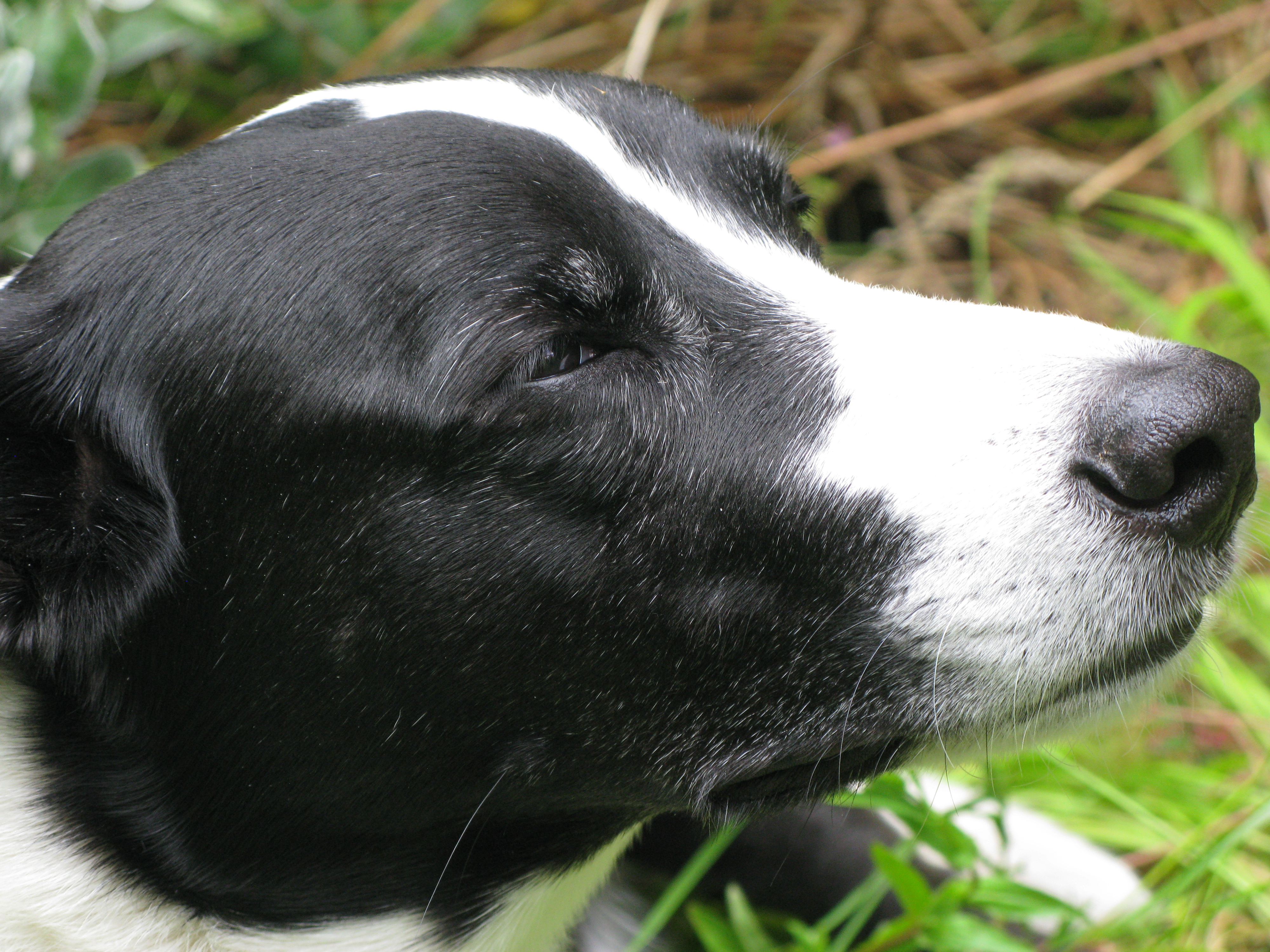
Molly

This rare black & white fox found at the bottom of our garden along with the faeries